Final Project

Group 13- Giovanna Larios, Samuel Juarez-Solis, Trey Lowe, Jaylynn Lyons, Corinne Mclntyre, Noah Su’A-Godinet 

On March 16th 2019, our group had the opportunity to embark on an adventure to the Womxn Who Rock Conference at the Centilia Cultural Center in Seattle Washington. This event invited the community to come together to have an experience that would open their minds to a new culture and perspective on music and dance. In this environment, individuals are able to join together and undergo sensitive topics such as sexism and racism with the use of dance and music. People were able to learn and watch dance and how there are intense meanings that go along with them. Our pictures and interviews are representations of the communal environment of this conference and express the diversity that electrified the room. We wanted to include images of the community learning and experiencing the dances and witnessing the love and excitement that brought such a unique spirit into the room. All members of the conference had a special quality to them which made this event so interesting and wonderful. You could truly see how the community came together as one while dancing and singing. Everyone appeared to be comfortable in their own skin and weren’t afraid to mess up or try something new.

Community member Eliana from Kent, learning Bomba and Jarocho, “Making Scenes.” 3/16/2019  Seattle, WA. By Trey Lowe.

This photo represents the category “Making Scenes”, because Eliana is a “Scene Maker”. As a participant in learning the bomba and Jarocho, she contributed to the success of the event. As individuals participating in the lesson, we were able to experience how important it is to gather with a community and learn traditions that are important to different groups of people.
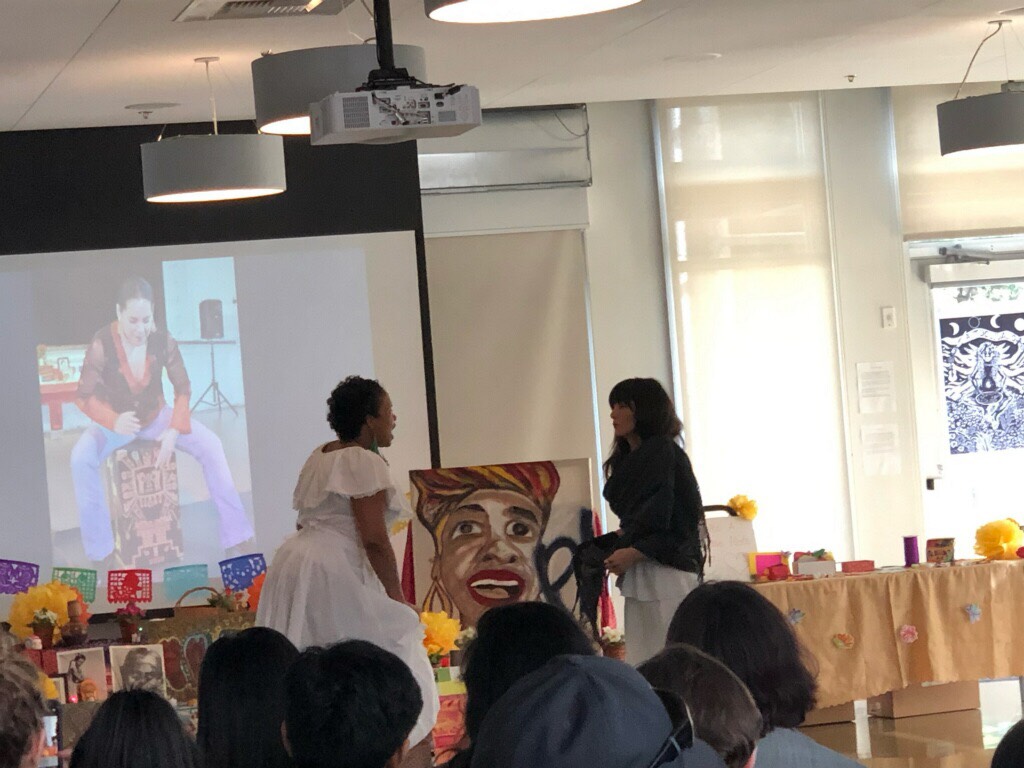
Iris Viveros, Afro-Puerto Rican bomba dancer, performing “ ?Que de donde vengo? ” “Building Communities.” 3/16/2019 Seattle, WA. By Trey Lowe.

In this photo Iris Viveros performs a deeply personal and emotional poem along with dance, and it is an example of the category “Building Communities”. This is because she is using her dance and spoken word to share her life story with the audience, creating a bond between the performer and viewer. This performance was very special as an audience member, and I felt that Iris Viveros shared a significant part of herself in her words and dance.

https://lh4.googleusercontent.com/iGEYBRa-MQtFo0T0Q0FLjHhps2vWlleB1MDcGepsTit1Hk8vWuf8kDzVSIvNTRm84TE4zL29_i4zHgmnnuXjgSm6HNrhN7E4gctKqZVIkC3TQDE8kU1ketdAA5XObKEP58Dk7zaH
The Altar and ofrendas at Women Who Rock (un)conference. “Building Communities.” 3/16/2019 Seattle, WA. By Trey Lowe.

This photo represents the category “Building Communities” because organizers set up this Altar before the event, and as the community gathered, they could watch a slideshow of previous WWR events, and observe all of the different artworks. This altar really represents how a community can come together and produce something both meaningful and beautiful.

https://lh5.googleusercontent.com/MuNl6tBUrIwAv7kmXDVloZV3XpR4-fcoIBs3gx53LQ-iki1Z8MaNXC2QFizNvpFKYNdmMoVCdtemxug9czkeEgnMlSosnAGera4iMx-JEmeeS6-tYUdONk0W0y8vqB7gE-bLtUFu
Jade Power Sotomayor leading the jarocho workshop. “Building Communities.” 3/16/2019 Seattle, WA. By Trey Lowe. 

In this photo, the drummers gathered represent the category “Building Communities”. It fits in this category because the drummers are communicating with each other, the dancers, and the audience. While doing so, they are spreading and teaching the jarocho tradition to others. As individuals in the audience, we were surprised by how included we all felt with the drummers. Learning the beats and rhythms through dance provided a genuine experience of community.

https://lh3.googleusercontent.com/NTWajhbHin1nFIzZi-tLoXCAO-dKdq_xCdbhwTmLvqlH6Cactb7vljvWlTeduvvsDVwf7t1-DQsrqOoyGqp5Gg4GBZPToUYvsv9pFh0sYApb9wjDpLHGFWKC_gq0WAkswIomfTc5
Dialogue by the panelist at Women Who Rock (un)conference in Seattle, WA. “Building Communities.” 3/16/2019. By Trey Lowe.

This photo represents the category “Building Communities” because there are many different people who contributed to the making of this event, and it wouldn’t have been the same without this diverse group of people. The panel was open to sharing there stories and passion about the event and how beautiful it is to see so many different individuals come together. By coming together, with the help of many others, they could create this event.

https://lh3.googleusercontent.com/v7Xibp0jAHD1RDtJwAKeCkKZ_vwXV633QX_l4kBQcLJRIsro-AKqoyYEN9XXobfx_rM5s3UMTdQUP5tNSJ_p2F36sEjp3iAysbqX-1AkTk1v_sL24CRwyVdy--YB48eGDbnbfcNV
Students, teachers, musicians, activists, writers, advocates, and community members gather to learn traditional Afro-Puerto Rican Bomba at WWR conference. Seattle WA. “Building Communities.”  3/16/2019. By Trey Lowe. 

Taking part in the learning of traditional Afro-Puerto Rican Bomba at the conference represents the category “Building Communities”, because the participation of the audience was important in the event’s goal to teach the community this traditional dance. Everyone was brought together to become familiarized with another cultures traditions not commonly seen everyday.

The conversations and performances that we watched at the conference went hand in hand to the topics that we covered in class. We were able to experience and learn how to perform Bomba, which was an illuminating experience to have. Seeing the excitement and smiles everyones faces had flowed throughout the whole venue. By talking to the community members, our group was able to witness the impact the conference has on each and every person. People found it a place where they could be theirselves and have an amazing time without judgement. Women and men from all different backgrounds at the conference were able to share their story and thoughts on the conference and how it has personally impacted them. What our group took away from this conference was that by working together as a community, a larger impact can be made. Moreover, as a group, we were able to collaborate and learn more from each other by completing our individual roles of the project. Overall, the Womxn’s conference was an enlightening and compassionate experience that allowed us to open our minds to new ideas that furthered our understanding on the concepts we covered in class.

Below is an interview with Sam as the interviewer and Weecho as the interviewee:

Sam:Hello I’m Sam, about to interview…

Weecho:Weecho

Sam: Weecho… okay so what does this (un)conference mean to you?

Weecho: The (un)conference means to me a place where you can be yourself, a place where you can learn, without judgement or fear of others, um just fun times. Just laughs all day. Moving your body, changing your mind, invoking the spirit, that’s what the (un)conference means to me.

Sam: Dang that’s beautiful, thanks

Weecho: Thanks.

Sam: Ah, second question. What is most significant to you about today?

Weecho: About today, hmm can I take a moment to think about that?

Sam: Yeah!

Weecho: thank you.

Weecho: The fact that it’s still going. I know they had some troubles last year, and they had to go over to Yakima. And there not over in capitol hill anymore. But the fact that they’re still here, and they’re still doing this, and Michelle’s energy is still amazingly up there… that to me is my takeaway for the day. It’s just great energy all around.

Sam: Dang, thanks so much Weecho!

Weecho: Yeah Sam no problem 

Sam: Awesome interview!

Weecho: And thanks much for coming up to me and asking.

Sam: Yeah thank you!

Below are the links to the live blog posts written by Jaylynn Lyons:

https://womenwhorockcommunity.org/2019/03/16/bomba/

https://womenwhorockcommunity.org/2019/03/16/women-who-rock-dance/

Online Film Response

Jaylynn Lyons

After the death of Mia Zapata who was raped and murdered, a group of women who had known her used their anger and rage to create “Home Alive.” “Home Alive” was an organization that offered self-defense classes and was open to everyone. The definition in the documentary is “Home alive is a collective of performance and visual artists hell-bent on fighting all forms of violence including (rape, domestic abuse, gay/lesbian bashing, racism and all other forms of oppression).”Their goal was to teach themselves and others’ techniques to protect themselves from any sort of violence. It was to encourage personal responsibility in dealing with confrontations in a small city with a predator on the loose. This group of women were careful on how they defined self-defense. They made it clear that it wasn’t all physical and that it set boundaries in people’s everyday lives. The film used the example of walking someone to their car as a way to use self-defense. The women explained how not everyone loved the idea of “Home Alive.” Some thought that it was making Mia a poster child, however, their only goal was to educate and make awareness of violence so that what happened to Mia would not happen again. They also encountered internal issues including disagreements. They wanted to create an accessible way for women to feel empowered and confident. The motive of “Home Alive” was to bring empowerment to women and to embrace your own strength. It gave women permission to have a voice and fight back. If I was able to create my own documentary, I would make it about racial discrimination. Although this was a greater issue in American history, it is still very prevalent today. 

Blog Post #4

Jaylynn Lyons

I found Gloria Anzaldua’s, “To live in the Borderlands means to you” to be a compelling poem expressing the hardships of fitting in and being accepted. Anzaldua describes the Borderland as a place where individuals have many ethnicities but aren’t accepted into any of them. The citizens that live in the Borderlands are “neither hispana india negra española ni gabacha, eres mestiza, mulata, half-breed caught in the crossfire between camps while carrying all five races on your back not knowing which side to turn to…” (Anzaldua, 118). I believe the poem in written in two language to convey the idea that people who live in the Borderlands know different languages. This concept can intensify the notion that numerous cultures are found in the Borderlands. The poem communicates thoughts of minority women and how they will not be left out of women’s rights movements. This correlates with the concept that woman cannot fail to notice all of the races that comprise her being. Lastly, this poem shows that mixing cultures while keeping your own identity is acceptable, however, you have to fight for it.         

In Laina Dawes’ interview, Zapata (who was brutally murdered) had friends who created “Home Alive, a nonprofit organization that promotes alternative methods for women to protect themselves within the community” (Dawes). Student from the University of Washington, Rozz Therrien says, “There was no sense on how the community responded outside of her friends, and how it felt during that time” (Dawes). Moreover, Michaels explains how it is “really weird [that] there was this lack of history talked about that no one of our generation knew about” (Dawes). In this interview, women empowerment is undermined. An interviewee proclaimed that some people may misunderstand self-defense as teaching women to beat up someone. To combine these thoughts, women promoting self-defense and the people who lived in the Borderlands were restrained. Needless to say, it comes across that people are apathetic towards these conceptions.

Many musicians have had a voice in promoting human rights. “Same Love” by Macklemore and Ryan Lewis immediately popped into my head since it is covering all concepts of equality whether it’s your religion, gender, or skin color. Another song that came to mind was “One Love” by Bob Marely. This song conveys the idea of world peace and shows oppression and injustice in his lyrics. There are so many artists that use their music to intensify opinions on human rights and current social issues. It is important to bring these matters into the light so that people can be educated and speak more about human rights.

Gloria Anzaldua “To Live in the Borderlands” (PDF)

Laina Dawes, https://www.bitchmedia.org/post/finally-filmmakers-tell-the-forgotten-history-of-seattle-diy-self-defense-group-home-alive (Links to an external site.)


Critical Karaoke U2

Jaylynn Lyons

U2

‘Beautiful Day’

All That You Can’t Leave Behind

4.08

Bono isn’t just good, he is extraordinary. He spends considerable time writing music that expresses ideas, thoughts, and emotions significant to his audience and the world. Bono weaves in personal stories and writes songs for his audience allowing them to reflect on their own lives to share a memory of their own. The song opens up with the unique sound of a reverberating electric piano playing over a string synthesizer which immediately lights me up when recognizing that it is my favorite song of all time. Bono wrote ‘Beautiful Day’ to speak to those who feel hopeless, stuck, or out of luck, but still finding joy in life. 

Life seems to have come to a stop. The house felt quieter; no yelling. I sense peace but feel sadness. I think to myself, where’s my dad?I’m in the car with my mom listening to U2 when ‘Beautiful Day’ begins to play. The perfect reminder that the human spirit cannot be smothered but can be protected in hard times. It’s important to realize that life is hard and can feel like we have no room to share it with anyone else, however, having a friend can increase your sense of belonging and purpose to help you realize that it is a beautiful day. The chorus electrifies the car with my mom and I both screaming out the lyrics thinking about nothing but the verses to follow. The upbeat rhythm strengthens the powerful lyrics throughout the song making it uplifting and optimistic. The ineffable beauty of the song is moving to those struck by disaster such as those a part of Hurricane Katrina in 2005. This song exemplifies hope that can be absorbed by a community or individual experiencing a low which for me was my parents’ divorce. Pain is proof of life since it reminds us there are things in our lives that aren’t perfect. It is crucial to be thankful for what you do have and celebrate that there is so much to live for. It’s a beautiful day. Don’t let the day be taken from you. Appreciate what is in front of you and soak in all of life’s beauties. Concentrate on the present and don’t let the past haunt you. Accept it and move forward.  

The world is against me. I’ll never be happy. Thoughts that have circled around my head over and over. God, show me the beauty in the world. Take me to that other place. Teach me. He tells me I am not a hopeless case. I catch myself looking out the window subtly seeing my reflection but taken away by the colors and beauty of Seattle Washington. 

See the world in green and blue

See the mountains right in front of you

See rainier broken by clouds 

See the salmon fleets clearing the sea out

See the stars shining at night  

See the needle at first light 

And see the bird with a leaf in her mouth

After the flood all of the colors came out 

This line references the story of Noah from the Bible. The flood resembles a period of depression but the bird with a leaf in its mouth brings content to the people and the rainbow after the flood is God’s promise that it would not happen again. It was a beautiful day. 

I understand why he is gone. There is an end to this darkness. Years have gone by, and I know that I am close to that other place. Good days, bad days, I want to find myself in that place of love, happiness, and prosperity. At the end of the song, Bono encourages everyone through his lyrics to be happy and realize that it’s a beautiful day despite the things you may not have. Human nature is to desire things that we can’t have or don’t have. It is time to start to live in an effortless and authentic way, not wishing for what you don’t need.  

If a flower can survive and flourish in inhospitable conditions, I can to. He isn’t here for a reason. I am happy, I am loved, I am complete. We all have an astonishing capacity to make progress, to find hope, and to absorb all of the beauty in the world. It is up to us to choose how we interpret and reflect upon what is around us. Everything we need to make it a beautiful day is right in front of us. Now I wake up every morning, and it’s a beautiful day. 

Blog Post Stream A #3

By: Jaylynn Lyons

 I found the power of feminism most compelling in this week’s readings. In Emily White’s, “The Great Indie Debate,” she expresses strong emotion on feminism in Indie Rock. Mary Lou Lord, a singer songwriter originally from Boston and resettled in Olympia, created a record on Kill Rock Stars and was one of numerous women indie artists that was pursued by major labels. Mary Lou Lord sang, “’I don’t fit into this indie world’” on her debut record. She is emphasizing her emotions in her song, “His Indie World,” however, her delivery “has an edge, and her lyrics call up images of scruffy boys (or male rock artists) …” (White, 475-476). The riot grrrls urged their listeners to “resist psychic death” and “cry in public” (White 476). They ranted against sexism and attacked feminist issues. Women musicians were always on the outside and “whether you were talking about indie or major, the world of rock in the early 1990s was primarily a man’s world” (White 476). The rise of indie-girl rock in the early nineties “often became a tale of clashes and bad blood” (White, 478). The antics and lack of agreement between performers shoes how women in power are as “complex and conflicted as men in power” (White 478). Women were still struggling to be accepted in the music industry, but some used their anger in their music and demeanor as they performed.

Similarly, with Alice Bag’s, “Violence Girl,” she conveys the notion of women’s power and how it is expressed in the music. The writing shows the energy and excitement on stage, “there is so much energy coursing through my body that surely I am dangerous to touch” (Bag, 7). I am able to visualize the performance being described, “I’m stomping, jogging and dancing all over the stage, teetering precariously on my high heels” (Bag, 7). The image created here is a woman who is using her power and energy on stage, much like how a male would in his performances to tell a story. It shows progression in women being a part of the indie rock world, and their influences on listeners. 

            I am not super familiar with many indie artists, however, after doing some research, I found a group named Camp Cope whose song, “The Opener” is directly related to women being overlooked in the music industry. It is a powerful song sung with a strong voice and has a catchy tune that will not leave your head! Another group I found named the Bully, have a song named “Kills to Be Resistant” that is sung by an amazing female artist that doesn’t only sing but plays the guitar. She is also the one who produced all of their records! I love how she has taken all initiative to be a powerful women in her group and be a leader. 

Emily White, “The Great Indie Debate,” Trouble Girls: The Rolling Stone Book of Rock (New York: Random House, 1997) (PDF)

Alice Bag, Violence Girl, selections (PDF)

U2 Political Influence Through Popular Music

          The Irish rock band U2 that formed in 1976 has continued to surprise me with their music that often embellishes sociopolitical themes. U2’s members are Bono (vocals), Edge (guitar and vocals), Adam Clayton (bass guitar), and Larry Mullen Jr. (drums). Not only is U2 known as the most musically innovative bands in history, but since the band has been together, they’ve been active through their voice and lyrics to change the world and people’s perspectives. U2 has achieved substantial commercial and critical success, selling millions of records and performing sold-out arena concerts well known for their unique visual effects. They have been acknowledged for their political dedication to humanitarian ideals and Christian principles. More specifically, U2’s “Songs of Experience” exploits ideas of masculinity and the power of having a voice and expressing emotion. Music is a chance to convey something ubiquitous, which connects with the artist’s and audience when they personally are struggling to put it into words. The euphoria in the arena gets people on their feet and into tears at how the artist targeted the feelings the listener is experiencing at that moment. Moreover, the combination of the rapture and elation that comes with sharing that feeling with thousands of people simultaneously. What is more rock and roll than that? I claim that “Songs of Experience” conveys the importance of expression and how masculinity is justified in popular music. I will discuss the controversy of masculinity in the music industry and how it correlates with expression using U2 as an individual example.

In an interview with Rolling Stone, Bono said, “I think music has gotten very girly.” He claims that with the exception of hip hop, the recording industry was lacking a place for young men to express their anger and thoughts at the world. Questions you might be asking are what about punk? Metal? Bono claims that music, along with other popular culture, has become feminized. People immediately shot down Bono’s notion accusing him of promoting male privilege. Expressing that male anger struggles to find a vent in popular music is dissimilar to saying that female anger either doesn’t exist or isn’t relevant. In “A Spy in the House of Love,” by Ann Powers, Ellen Willis a feminist critic of rock writes, “Individuals, [communities, and society] could be enlightened by the ‘ecstatic experience’ of visions expressed through music’s rhythm and noise and that such joy might lead us to create different ways of loving and sharing power” (Powers, 40). Jennifer Lena notes in “Music Genres Hip Hop” that, “music is a participatory, community-based activity…we discover more evidence that debates over political content of music is keyed to the scale of the community size” (Lena, 3). Bono as an activist, hopes to use his music to share his feelings and emotion toward political views in hopes that his listeners will work to make a change with him.

U2’s most recent album, “Songs of Experience” reflects the political and personal annihilation that bono felt had happened in his life. In “Pop; When the World Falls Apart,” Weisbard said, “no book on music in troubled times could avoid the theme of anger…” (Weisbard, 5). Men are told that they can’t be angry and that their anger is menacing. In the song, “Get Out of Your Own Way,” Bono expresses his frustration towards Trumps politics. Moreover, he tried to use some irony to reflect the anger of individuals out on the streets using the line, “Fight back, don’t take it lying down you’ve got to bite back.” Bono explained in the Rolling Stone, “when I was 16, I had a lot of anger in me. You need to find a place for it and for guitars, whether it is with a drum machine – I don’t care.” Bono is stressing the importance of having a voice and eliminating fear of having a loss in masculinity. 

Men are being encouraged to be themselves, but only if their selves are allowable to others. Men should be encouraged to embrace their vulnerability and admit their feelings rather than complying with inherited ideas of what it means to be a man. Bono admits that “Songs of Experience” isn’t for everybody, but for him it felt right. His last two albums, “Songs of Innocence” and “Songs of Experience” are a combination of personal and political so that you don’t know which one you are listening to. Overall, embracing your feelings and having the willingness to share them with an audience is important to engage with listeners and release internal emotions. The Edge in the Rolling Stone says, “I think every time we make a record, we learn.” U2’s aspirations are to continue to find desire somewhere to incorporate into their music.

Critical Models:

https://www.rollingstone.com/music/music-features/the-edge-on-u2s-experience-tour-this-is-for-our-committed-fans-628392/
https://www.rollingstone.com/music/music-news/the-broken-heart-and-violent-fantasies-of-lady-gaga-79462/

References:

Ann Powers, “A Spy in the House of Love,” Women & Music, Volume 12, 2008 (PDF)

Belam, M. (2017, December 28). Music has ‘gotten very girly’, says Bono from U2. Retrieved from: https://www.theguardian.com/music/2017/dec/28/music-has-gotten-very-girly-says-bono-from-u2

Bono: ‘Music has gotten very girly’. (2017, December 28). Retrieved from: https://www.bbc.com/news/entertainment-arts-42502453

Eric Weisbard, “Introduction.” Pop When the World Falls Apart: Music in the Shadow of Doubt (Duke 2012) (PDF)

Jennifer Lena, “Music Genres,” Banding Together: How Communities Create Genres in Popular Music (Princeton Univ. Press, 2012) (PDF)

Individual Blog Post #2

Jaylynn Lyons

In the reading, “The Stage Hip-Hop Feminism Built: A New Directions Essay,” I specifically loved how powerful and engaging the concepts were. Hip hop feminism (black feminism) highlights that “personal is political” (Wikipedia) because of race, class, gender, and sexuality that determines how individuals are treated. I am passionate about the notion of women empowering women which correlates with hip-hop feminism and their actions of using their music to make statements.

Particularly, I found the idea of Afrofuturism to be captivating and a direct connection with hip-hop feminism and their goals to express their truth. Joan Morgan, an American author and journalist, believes “…truth can’t be found in the voice of anyone rapper but the juxtaposition of many” (Wikipedia). Afrofuturism is described as a black perspective on the “histories of people of color and visions of the future with people of color at the center while simultaneously critiquing dominant systems of power and subjugation” (Durham, 733). I believe that many artists are activists through their music.

In the Q & A, “Still Fighting the Power,” Jeff Chang says, “I think hip hop tells the hidden story of the latter part of the twentieth century and the beginning of this century… and, by extension, what has happened in and amongst youth all around the world.” Furthermore, he goes on to use Hamada Ben Amor as an example of someone who used their music to “protest against the regime.” Through his music, Hamada was able to give the audience “a sense of an uprising in ideas that translated into this physical commitment that overturned the regime — then led a domino effect across the Arab world.”

A popular band U2 is very known for their political contributions in their music. In one of their newer songs, “Get Out of Your Own Way,” they are criticizing racism in the United States and taking a stance through their lyrics. The song was performed at the Grammy’s in 2018 which was claimed to be a pretty political night. The song was indirectly poking at Donald Trump and there were also other performers who expressed their political concerns through their music including Kesha who performed “Praying” as a powerful celebration of women’s solidarity. 

U2 “Get Out of Your Own Way”

“Praying”

References:

Aisha Durham, Brittney C. Cooper, and Susana M. Morris, “The Stage Hip-Hop Feminism Built: A New Directions Essay,” Signs, Vol. 38, No. 3 (Spring 2013) (PDF)

Bill Moyers Show interview, Theresa Riley with Jeff Chang, Q & A: Still Fighting the Power (Links to an external site.)Links to an external site.

Jaylynn’s Individual Blog Post #1 Stream A

By Jaylynn Lyons

After reading Mahon’s piece, “’Big Mama’ Thornton’s Voice,” I felt frustrated for Thornton due to her troubling circumstances. Her identity as a black woman “made it difficult to hear and see [her] in all of her resonant dimensions…” (Mahon, 1). As we previously witnessed in Twenty Feet from Stardom, female black artists were less appreciated and acquired little success since male artists overlooked black women’s influence on rock and roll. Thornton’s song “Hound Dog” was recreated by Elvis Presley and became the “best-known” and “best-selling” version of the song (9). I can’t imagine the anger Thornton felt becoming the “stepping stone to someone else’s success while struggling to establish a viable career of her own” (Mahon, 9). 

I was enlightened to read about Thornton’s relationship with Joplin who “invited Thornton to open for her on a couple dates, something Presley never did” (Mahon, 13). The two of them shared success with each other and Thornton even gave Joplin consent to make ‘Ball and Chain.’ It was inspiring to read that Joplin gave Thornton credit for the song which she appreciated after being uncredited by Presley. Thornton was certainly not the only one who had another artist take their work and make greater benefits from it. In the end, Thornton never addressed her feelings toward Presley and she simply went on with it internally driving her to work her way up the ladder. I loved the connection that I found between this story and the WWR where women of all colors are encouraged to have a voice and express their feelings and share their personal stories (6). The goal of this program is to “create an open structure through which unexpected, transformative and even healing conversations might emerge” (Habell-Pallán, 4). It is important to note the significance of having a voice and expressing feelings of frustration and annoyance. The WWR also poses the point that the project is a collective effort and we “all come from different locations within the university and community” (Habell-Pallán, 5). As a result, it is important to remember that even though we don’t all come from the same place we all have the same chance to make big changes and have opinions in the world and in music.

Another example of a Presley and Thornton scenario where the cover of the song was created by a white artist is Cherelle/Jimmy Jam and Terry Lewis and Robert Palmer. The original song, “I Didn’t Mean to Turn You On” was created by Cherelle https://www.youtube.com/watch?v=wmMwpi1iUUw but was later covered by Palmer https://www.youtube.com/watch?v=2YO0WyOGHjU who hit number two on the Billboard Hot 100. The original version only hit number 79 on the Billboard Hot 100 which I’m sure was incredibly frustrating for Cherelle who’s version was beautiful to many people even though it was labeled as “unpopular” due to its ranking.

Works Cited:

Maureen Mahon, “Listening for Willie Mae “Big Mama” Thornton’s Voice: The Sound of Race and Gender Transgressions in Rock and Roll,” Women and Music, 15, 2011, 1-17. (PDF)

Michelle Habell-Pallán, Angelica Macklin and Sonnet Retman, “Notes on Women Who Rock: Making Scenes, Building Communities: Participatory Research, Community Engagement, and Archival Practice.” NANO (New American Notes Online) special issue, “Digital Humanities, Public Humanities.” July 2014. (PDF)