Final Project

Group 13- Giovanna Larios, Samuel Juarez-Solis, Trey Lowe, Jaylynn Lyons, Corinne Mclntyre, Noah Su’A-Godinet 

On March 16th 2019, our group had the opportunity to embark on an adventure to the Womxn Who Rock Conference at the Centilia Cultural Center in Seattle Washington. This event invited the community to come together to have an experience that would open their minds to a new culture and perspective on music and dance. In this environment, individuals are able to join together and undergo sensitive topics such as sexism and racism with the use of dance and music. People were able to learn and watch dance and how there are intense meanings that go along with them. Our pictures and interviews are representations of the communal environment of this conference and express the diversity that electrified the room. We wanted to include images of the community learning and experiencing the dances and witnessing the love and excitement that brought such a unique spirit into the room. All members of the conference had a special quality to them which made this event so interesting and wonderful. You could truly see how the community came together as one while dancing and singing. Everyone appeared to be comfortable in their own skin and weren’t afraid to mess up or try something new.

Community member Eliana from Kent, learning Bomba and Jarocho, “Making Scenes.” 3/16/2019  Seattle, WA. By Trey Lowe.

This photo represents the category “Making Scenes”, because Eliana is a “Scene Maker”. As a participant in learning the bomba and Jarocho, she contributed to the success of the event. As individuals participating in the lesson, we were able to experience how important it is to gather with a community and learn traditions that are important to different groups of people.
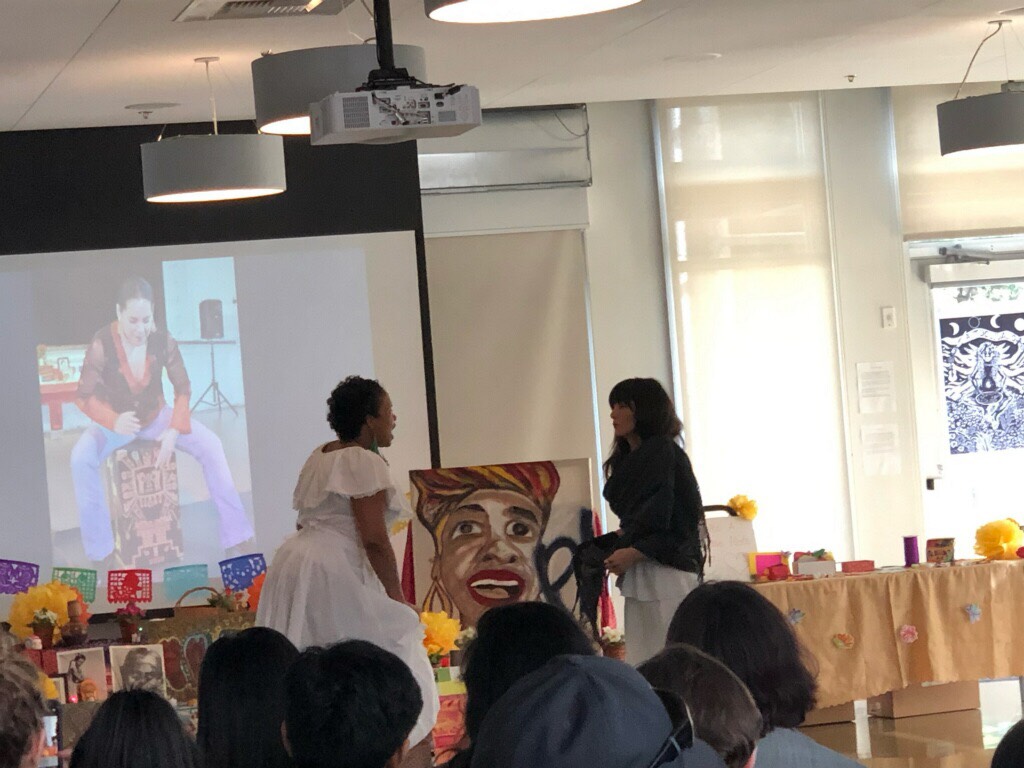
Iris Viveros, Afro-Puerto Rican bomba dancer, performing “ ?Que de donde vengo? ” “Building Communities.” 3/16/2019 Seattle, WA. By Trey Lowe.

In this photo Iris Viveros performs a deeply personal and emotional poem along with dance, and it is an example of the category “Building Communities”. This is because she is using her dance and spoken word to share her life story with the audience, creating a bond between the performer and viewer. This performance was very special as an audience member, and I felt that Iris Viveros shared a significant part of herself in her words and dance.

https://lh4.googleusercontent.com/iGEYBRa-MQtFo0T0Q0FLjHhps2vWlleB1MDcGepsTit1Hk8vWuf8kDzVSIvNTRm84TE4zL29_i4zHgmnnuXjgSm6HNrhN7E4gctKqZVIkC3TQDE8kU1ketdAA5XObKEP58Dk7zaH
The Altar and ofrendas at Women Who Rock (un)conference. “Building Communities.” 3/16/2019 Seattle, WA. By Trey Lowe.

This photo represents the category “Building Communities” because organizers set up this Altar before the event, and as the community gathered, they could watch a slideshow of previous WWR events, and observe all of the different artworks. This altar really represents how a community can come together and produce something both meaningful and beautiful.

https://lh5.googleusercontent.com/MuNl6tBUrIwAv7kmXDVloZV3XpR4-fcoIBs3gx53LQ-iki1Z8MaNXC2QFizNvpFKYNdmMoVCdtemxug9czkeEgnMlSosnAGera4iMx-JEmeeS6-tYUdONk0W0y8vqB7gE-bLtUFu
Jade Power Sotomayor leading the jarocho workshop. “Building Communities.” 3/16/2019 Seattle, WA. By Trey Lowe. 

In this photo, the drummers gathered represent the category “Building Communities”. It fits in this category because the drummers are communicating with each other, the dancers, and the audience. While doing so, they are spreading and teaching the jarocho tradition to others. As individuals in the audience, we were surprised by how included we all felt with the drummers. Learning the beats and rhythms through dance provided a genuine experience of community.

https://lh3.googleusercontent.com/NTWajhbHin1nFIzZi-tLoXCAO-dKdq_xCdbhwTmLvqlH6Cactb7vljvWlTeduvvsDVwf7t1-DQsrqOoyGqp5Gg4GBZPToUYvsv9pFh0sYApb9wjDpLHGFWKC_gq0WAkswIomfTc5
Dialogue by the panelist at Women Who Rock (un)conference in Seattle, WA. “Building Communities.” 3/16/2019. By Trey Lowe.

This photo represents the category “Building Communities” because there are many different people who contributed to the making of this event, and it wouldn’t have been the same without this diverse group of people. The panel was open to sharing there stories and passion about the event and how beautiful it is to see so many different individuals come together. By coming together, with the help of many others, they could create this event.

https://lh3.googleusercontent.com/v7Xibp0jAHD1RDtJwAKeCkKZ_vwXV633QX_l4kBQcLJRIsro-AKqoyYEN9XXobfx_rM5s3UMTdQUP5tNSJ_p2F36sEjp3iAysbqX-1AkTk1v_sL24CRwyVdy--YB48eGDbnbfcNV
Students, teachers, musicians, activists, writers, advocates, and community members gather to learn traditional Afro-Puerto Rican Bomba at WWR conference. Seattle WA. “Building Communities.”  3/16/2019. By Trey Lowe. 

Taking part in the learning of traditional Afro-Puerto Rican Bomba at the conference represents the category “Building Communities”, because the participation of the audience was important in the event’s goal to teach the community this traditional dance. Everyone was brought together to become familiarized with another cultures traditions not commonly seen everyday.

The conversations and performances that we watched at the conference went hand in hand to the topics that we covered in class. We were able to experience and learn how to perform Bomba, which was an illuminating experience to have. Seeing the excitement and smiles everyones faces had flowed throughout the whole venue. By talking to the community members, our group was able to witness the impact the conference has on each and every person. People found it a place where they could be theirselves and have an amazing time without judgement. Women and men from all different backgrounds at the conference were able to share their story and thoughts on the conference and how it has personally impacted them. What our group took away from this conference was that by working together as a community, a larger impact can be made. Moreover, as a group, we were able to collaborate and learn more from each other by completing our individual roles of the project. Overall, the Womxn’s conference was an enlightening and compassionate experience that allowed us to open our minds to new ideas that furthered our understanding on the concepts we covered in class.

Below is an interview with Sam as the interviewer and Weecho as the interviewee:

Sam:Hello I’m Sam, about to interview…

Weecho:Weecho

Sam: Weecho… okay so what does this (un)conference mean to you?

Weecho: The (un)conference means to me a place where you can be yourself, a place where you can learn, without judgement or fear of others, um just fun times. Just laughs all day. Moving your body, changing your mind, invoking the spirit, that’s what the (un)conference means to me.

Sam: Dang that’s beautiful, thanks

Weecho: Thanks.

Sam: Ah, second question. What is most significant to you about today?

Weecho: About today, hmm can I take a moment to think about that?

Sam: Yeah!

Weecho: thank you.

Weecho: The fact that it’s still going. I know they had some troubles last year, and they had to go over to Yakima. And there not over in capitol hill anymore. But the fact that they’re still here, and they’re still doing this, and Michelle’s energy is still amazingly up there… that to me is my takeaway for the day. It’s just great energy all around.

Sam: Dang, thanks so much Weecho!

Weecho: Yeah Sam no problem 

Sam: Awesome interview!

Weecho: And thanks much for coming up to me and asking.

Sam: Yeah thank you!

Below are the links to the live blog posts written by Jaylynn Lyons:

https://womenwhorockcommunity.org/2019/03/16/bomba/

https://womenwhorockcommunity.org/2019/03/16/women-who-rock-dance/

Individual Blog Post Stream B #4 Corinne McIntyre

            Hip-Hop and activism have a strong connection, dating back to its use as a form expression for the African Americans, Caribbean immigrants, and Puerto Ricans in the South Bronx, who were left in a poverty-stricken ghetto after the construction of the Cross-Bronx, (Berrios-Miranda, Dudley, and Habell-Pallan, 209). These roots led the path for Hip-Hop to continue to be used as a platform, “which to voice marginalized people’s desires, opinions, and resistance to the conditions in which they found themselves,” (Gonzalez, 7). One of the players in Hip-Hop activism today is Jay-Z. From the start of his career, Jay-Z was aware of how record labels took advantage of their hip-hop stars, and instead of jumping on a record deal, he had to make it on his own. As an independent artist, he had to sell his music on his own, and make a name for himself from nothing. Considering how well he has done as an artist, as one of the first rappers to become a billionaire, Jay-Z’s tactics, talent, and drive have really paid off. Jay-Z is an alternate imaginary in every sense of the term stating, “Our ambition was never to just fit into the corporate mold, it was to take it over and remake that world in our image,” (Hogan). Jay-Z has not kept his success to himself though, and without the public eye even knowing, has bailed out numerous rappers from jail like 21 savage and Meek Mill, who have spoken out about their gratitude for him. Along the same lines, Jay-Z wired tens of thousands of dollars within minutes to bail Baltimore protesters, (Lewis). Jay-Z writes about police brutality, toxic masculinity, and a number of other social critiques in his music. Jay-Z is one of the most influential rappers who are continuing and even exceeding Hip-Hop’s history of activism, expression, and social movement.

“Wesley’s Theory” Kendrick Lamar

“The Story of OJ” Jay-Z

I picked these songs because of their social commentary, one as an example of Jay-Z’s social critique, and another addressing the exploitation of black artists by the entertainment industry. “The Story of OJ” has a very interesting music video which has many depictions of slavery, and America’s consumerist and capitalist society. He talks about racism, and sends a message that no matter how much money or status a marginalized person obtains, they will always be oppressed by racist people. “Wesley’s Theory” by Kendrick Lamar starts references African American Wesley Snipes, who went to jail for failure to pay taxes, using it as an example of how black artists are both targeted and exploited. He talks about rappers need to blow all the money they earn on material things, because that is what in valued in our culture, but can end up leaving people with nothing.

Works Cited

Martha Gonzalez, “Imaginaries,” Liner notes, co-authored with Russell Rodriguez for Quetzal, Smithsonian Folkways Recordings. (PDF)

Marisol Berrios-Miranda, Shannon Dudley, Michelle Habell-Pallán. Chapter 4 in American Sabor: Latinos and Latinas in US Popular Music/American Sabor: Latinos y Latinas en La Música Popular Estadounidense.

Ashitey, Tiffany, and Taylor Lewis. “The 10 Not-So-Publicized Times Jay Z and Beyonce Gave Back.” Essence, ESSENCE, 28 Sept. 2018, http://www.essence.com/lifestyle/do-good-brothers/10-not-so-publicized-times-jay-z-and-beyonce-gave-back/.

Hogan, Marc, and Marc Hogan. “Every Corporate Deal That Brought JAY-Z Closer to Becoming Rap’s First Billionaire.” Pitchfork, Pitchfork, 27 June 2017, pitchfork.com/thepitch/every-corporate-deal-that-brought-jay-z-closer-to-becoming-raps-first-billionaire/.

Blog post stream B #4

Trey Lowe

This weeks reading was very interesting to me.  They were about Chicano’s in a primarily white institute.  Most the time these things are not talked or learned about but just ignored and forgotten.  The owner is a chicano and her name is Martha Gonazalez.  Her lectures and research are a main staple of the webisite.  You can learn a lot from this website about Chicano music and art.  She has represented Chicanos everywhere by what she has done with her life and this is what intrigues me the most.  People can now look at her for motivation and inspiration.  She points out on her website that Chicanos have had an influence on every single music category pretty much.  These are the things that are not learned about and I think people should speak and learn about how influences impact the next version of music. 


Blog Post B #4 Giovanna Larios

This week’s readings were really interesting even more because they were about chicanos and In a white institute it’s rare to learn about chicano and latin music or even history. The website by Martha Gonzales a chicana artivitsa, PhD has a lot of great context. There are tabs for academia, in this tab she has previous lectures, research, and even her conference and panel presentations. In the Music tab she has different music information and songwriting, the songs are Latinx music and indigenous culture.

In Her bio it talks about how big of an impact she’s made on the music and education as a chicana. As a Chicana myself it’s really empowering to see how other Chicanas are taking up space and challenging whiteness. She has represented “Chicano in spaces such as the U.S. Library of Congress and The Kennedy Center in September of 2011”. This is the type of things I enjoy learning and reading because it gives me a sense of belonging and empowerment. The article American sabor  was also very interesting. It was actually funny I didn’t notice it was in spanish when I first started reading the chapter. I started reading and about half way down I realized it was in spanish. In the section Hip-Hop Y Sus Parientes I found interesting that it talked about the disco music with a hint of chicanismo. She says they start with “la campana y la conga, seguida por la linea del bajo” which translates to they start with the bell and conga, and then add the bass line. Before this course I would of never thought about punk, disco , hiphop to have been inspired or even have a little bit of latino in them. I really enjoyed learning the different origins of modern music.

Blog Post Stream A #1

Noah Sua-Godinet

The readings I have decided to discuss was Daphne Brooks The Right to Rock and Maureen Mahon’s Rock. These two readings connected as both covered the feminist side of music, mainly focused on rock and roll. In Mahon’s Rock, it discusses the a few types of rock and roll styles that female artist used, but unfortunately those styles were taken by male artist. These male artists took those styles, made it their own, and became famous off of them. An example of this would be when, “Dorothy La Bostrie wrote the lyrics for the well-known Little Rickie Song Tuttie Fruttie” (Mahon 558). Songs were not the only thing taken as mentioned, “Tina Turner taught Mick Jagger how to dance the Pony and he incorporated this and other Turner-esque mannerisms into his show” (Mahon 558). When it comes to women and rock and roll you have to know about Ellen Willis. Brooks The Right to Rockgives us a history of legendary male artist that got their talents from a mythical and magical guitar pick. The history only consists of male artist which leads you to assume that this genre was male dominated. This is where Ellen Willis comes in as she changed everyone’s perspective of men ruling rock and roll. Brooks acknowledged, “the doors that Ellen Willis kicked open in the sixties, seventies, and eighties” (Brooks 58). Willis was able to, “open dense equations of gender, class, power, and subculture music scene…like no one before her…and find a way from the inside to record, in her own words, the sound of liberation” (Brooks 59).  

https://youtu.be/qs5Zm2fFxjU

https://youtu.be/j0f5ZG9LG6k

Online Film Response (Rock, Rage, and Self Defense)

Noah Sua-Godinet

The “Home Alive” movement was formed due to unfortunate events, such as the rape and murder of Mia Zapata, that occurred in a small city. A main concern was staying alive while all this violence were happening against women. After seeing a violent act being done to a women with such a high stature in her community they feared it would could happen to everyone so some of her close friends created this “Home Alive” movement to teach women self defense free of charge. When defining self-defense they made it clear that it went further than just physical defense and was a means of doing what is necessary to stay alive. Like every new idea there always comes people who disagree, internally and externally, as the women shared some of these disagreements. One externally issue they faced were the wanting of the “Home Alive” movement in different areas, but the women in lead thought it was best to keep in the city it started. An internal issue they faced was the members allowed to participate in the group. The argument of whether or not the allow transgenders to participate was an issue that made some participants uncomfortable. “Home Alive” matters because it was formed by a group of women who took the initiative to stand against something they saw was wrong and make a difference world wide. They legacy of this Movement is the empowerment of women with knowledge and the use of their voice to stand up for themselves in turn lessening the chases of what happened to Mia Zapata from happening again. If I could make a documentary film it would be about J. Cole because to this day he is using his music to educate the younger generations on what this world brings and how each and every one of us can make our own difference.

Film response

The home alive collection formed because of things that were happening in the city at the time. Things such as rape and assault on women.  They were asking how they were supposed to get home alive with all these rapes and violence happening against women.  They defined self defense as doing as much as they can to defend themselves.  Not just physical self defense but verbal and other ways and anything that keeps them alive.  One of the tensions that came from is was people who knew Mia and they felt as if Home Alive was trying to turn her into a poster child for this and they didn’t like that.  They also faced tensions in the group like long discussions and arguments on topics, one topic being if they should allow men or transgender people in the self defense classes.  Home alive matters because the founders were regular people and they saw an issue and decided to take action, not just stand by and watch others get murdered and raped, they wanted to do something about it.  It also matters because I don’t think that women are taught enough self defense but rather told what to do and what not to do, which should not be the case. I would make a documentary on Tupac Shakur because he tried to make a bigger impact on the world and the communities than many people know, and his impact is stil alive today. 

Online Film Response

Jaylynn Lyons

After the death of Mia Zapata who was raped and murdered, a group of women who had known her used their anger and rage to create “Home Alive.” “Home Alive” was an organization that offered self-defense classes and was open to everyone. The definition in the documentary is “Home alive is a collective of performance and visual artists hell-bent on fighting all forms of violence including (rape, domestic abuse, gay/lesbian bashing, racism and all other forms of oppression).”Their goal was to teach themselves and others’ techniques to protect themselves from any sort of violence. It was to encourage personal responsibility in dealing with confrontations in a small city with a predator on the loose. This group of women were careful on how they defined self-defense. They made it clear that it wasn’t all physical and that it set boundaries in people’s everyday lives. The film used the example of walking someone to their car as a way to use self-defense. The women explained how not everyone loved the idea of “Home Alive.” Some thought that it was making Mia a poster child, however, their only goal was to educate and make awareness of violence so that what happened to Mia would not happen again. They also encountered internal issues including disagreements. They wanted to create an accessible way for women to feel empowered and confident. The motive of “Home Alive” was to bring empowerment to women and to embrace your own strength. It gave women permission to have a voice and fight back. If I was able to create my own documentary, I would make it about racial discrimination. Although this was a greater issue in American history, it is still very prevalent today. 

On-line Film Response–Rock, Rage and Self-Defense

Samuel Juarez-Solis

  • Why did the Home Alive collective form?
    • The Home Alive collective was formed in response to the rape and murder of the  singer Mia Zapata. The community felt unsafe, especially because they thought Zapata was such a powerful figure and never imagined someone like her being raped and murdered. A group of local musicians and artists close to Zapata decided to raise money to teach free self-defense classes to people who usually can not afford them.
  • How did the Home Alive collective define self-defense?
    • The Home Alive collective defined self-defense as any means to keep oneself alive. Whether it be by physical means, guns, or escape routes the person had to stay alive.
  • What are some of the issues and tensions the Home Alive collective faced once they became an organization?
    • One issue the Home Alive collective faced once they became an organization is that many places around the world wanted a Home Alive branch, but the members thought it would best to just stay local. Also, there was a problem of who was allowed to go to the sessions. One member complained they were uncomfortable that a person who identified as a woman had a penis. But the head members believes violence permeated through the lives of everyone so they let anyone join.
  • Why does the work and approach of Home Alive matter? What is the organization’s legacy?
    • The work and approach of Home Alive matters because heinous crimes like rape and murder can be avoided if people have the proper self-defense techniques. The organization’s legacy is that they now have a website and are able to reach millions around the world. Whether they liked it or not, the organization did have feminism undertones that promoted the lives of women.
  • This documentary emerged out of the oral histories that students conducted in the first version of this class in 2011. If you could make a documentary film on an artist, scene or music’s relationship to social activism, what would it be about? Why?
    • I would make a documentary film about Freddie Mercury in support of the L.G.B.T.Q.I.A.+ community. I feel like that community is facing a tremendous hardship right now and a documentary about one of society’s beloved rock stars would be a huge encouragement to support the lives of L.G.B.T.Q.I.A.+ people.

Individual Blog Post #4

Noah Sua-Godinet

Gloria Anzaldua’s poem, “To live in the Borderlands means you” Is compelling in the way that it expresses the struggle and constant perseverance to fit in. Anzaldua even states, “In the Borderlands…you are at home; a stranger…” (Anzaldua). Anzaldua is painting this picture of s groups of mixed people, “neither hispana india negra española ni gabacha, eres mestiza, mulata, half-breed caught in the crossfire between camps while carrying all five races on your back not knowing which side to turn to, run from” (Anzaldua). These mixed people are basically having nowhere to go and not sure who to turn to base on the fact that they are not accepted by any of their ethnic backgrounds. This poem is showing the struggle that comes with the acceptability of being made up of many different cultures. In all honestly, I was ignorant to the Borderlands and the situation of the people living there and I’m sure I am not the only one who has no knowledge of what seems to be an important part of history. The lack of urgency to acknowledge this piece of history provokes the thought that it isn’t important to society. 

A self-defense group called “Home Alive”, another small but important part of history that you would think would be brought up often, was mentioned in Laina Dawes Interview is an, “organization that promotes alternative methods for women to protect themselves…”(Dawes). I agree with an interviewee, Leah Michaels, when she strikes the questions, “How is this not a huge thing? How do people not know about this at all?” (Dawes). Especially in today’s society with all of the issues of abuse, I don’t understand how this movement is haven’t surfaced once more. Again showing lack of importance to a movement in history such as this provokes the thought that women safety means little to society. 

Video Links

https://www.youtube.com/watch?v=8V0cfqqRYSs

https://www.youtube.com/watch?v=WpYeekQkAdc